Poca

Poca

A mobile-first AR postcard platform.

Year

2026

Role

Founder /Product & Full-Stack AR Engineer

↓ Scroll to continue
0:000:00
View team (4)

David Kuo

Founder / Product & Full-Stack AR Engineer

Leads XR engineering, front-end, AR pipeline, and product strategy.

Xiaoming Zhang

Head of Product Experience

Owns user flows, information architecture, and the end-to-end journey from first open to first send.

Lujia Xu

Head of User Research

Runs interviews, testing, and the insight-to-spec pipeline that shapes every decision.

Jiayi Hu

Head of Brand & Visual

Directs the Ghost White identity, visual system, and the printed-card art direction.

Giving postcards a digital home

PoCA explores how voice, location, and digital objects can be attached to a physical postcard, so more of the sender’s original emotion and context can be experienced again later.

Postcards preserve words and images, but not always the full emotional context in which they were sent. Over time, the sender’s voice, location, and intention can fade, even when the physical card remains.

Tools & Software

Next.js 15MindARThree.jsSupabaseCloudflare R2

Categories

ARXRInteractiveWebsiteWeb-based AR

How It Works

Send a Postcard

The sender photographs a physical postcard, adjusts the image target, and creates its digital counterpart. They can then add a voice message, location tag, and AI-generated 3D object before generating a shareable link.

Step 1 of 5Photograph your postcard

Receive a Postcard

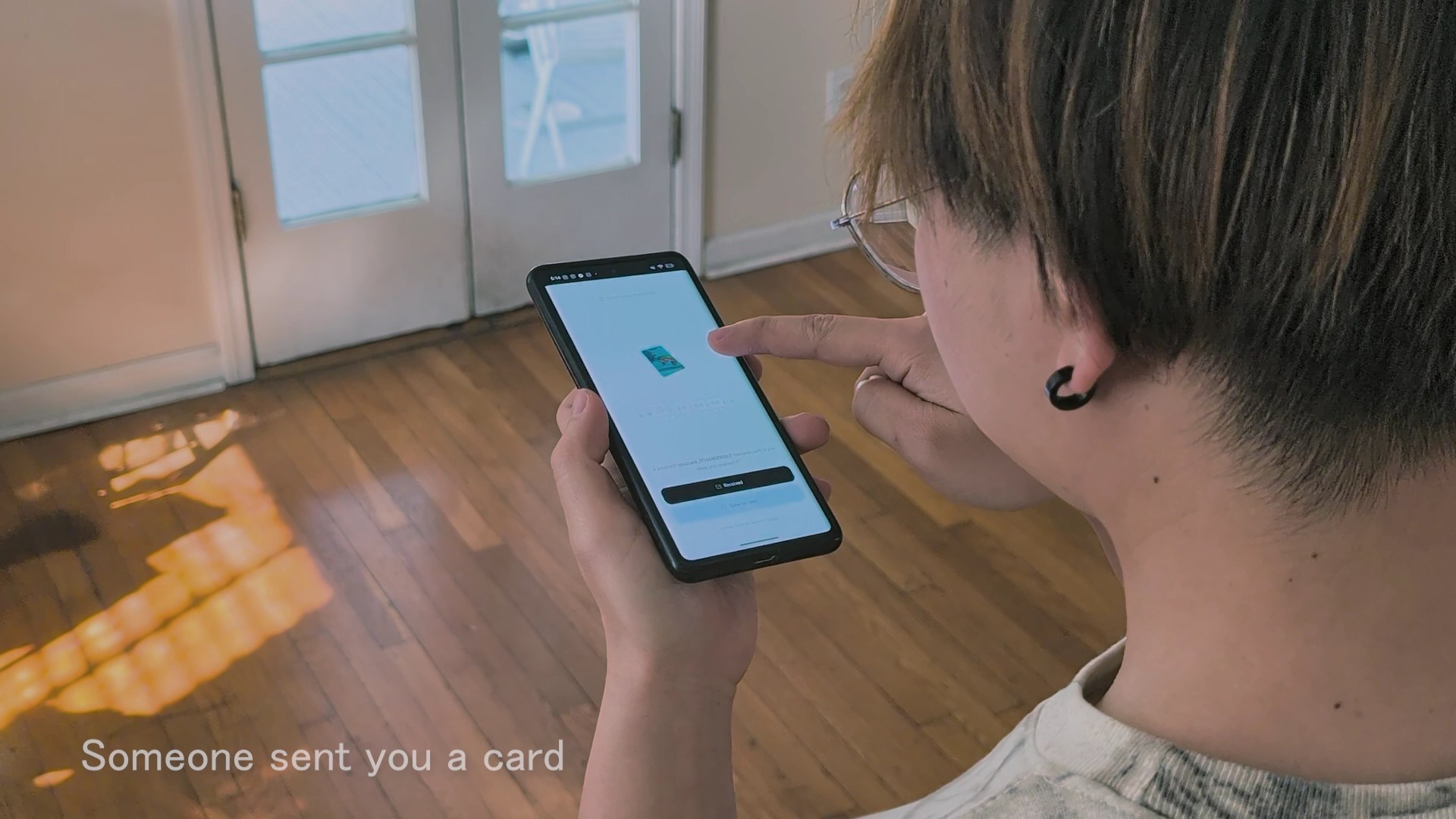
The recipient opens the shared link, taps Receive, and scans the physical postcard. PoCA recognizes the image target and reveals the attached AR voice, location, and 3D content. The postcard can then be saved to an Album.

Step 1 of 5Open the shared link

Product Process

AI-Assisted Product Development

AI was used as an active development partner across the idea-to-product loop: clarifying product behavior, exploring implementation paths, generating and refining code, debugging browser and AR edge cases, and turning Devlog findings into reusable engineering decisions. The value was not a list of tools; it was shortening the distance between a product question and a testable interaction.

Research

  1. Define the product problem
  2. Survey to focus the problem
  3. Review findings & define core features

Parallel development

Engineering

Plan app architecture with AI

Claude Code · Codex · Kiro

UX

Prototype & refine low-fi user flows

FigJam · Figma Make

Graphic

Define the product’s visual direction

FigJam · Figma Make · Claude Design

Build & learn

  1. Integrate the work
  2. Debug & refine
  3. Test with users
  4. Collect survey feedback

↺ Use feedback to refine the next iteration

Technology

Choosing Web Over Native

Web shortened the distance from idea to testable product: no app installation, direct access through a URL, immediate deployment updates, and a lower-friction environment for early testing and iteration.

WebPoCA’s choicevs Native
  • Web
    Deploy and test in the browser
    Native
    Build, install, and distribute
  • Web
    Open a link · no installation
    Native
    Install the app first
  • Web
    One web app across supported browsers
    Native
    Platform-specific builds and APIs
  • Web
    Limited to supported browser APIs
    Native
    Deeper native API access
  • Web
    Publish updates directly to the web
    Native
    Store packaging and review

Selecting the AR Framework

PoCA moved from 8th Wall to MindAR for a more flexible image-target workflow: compiling new postcards in the browser and managing our own target library, while accepting a trade-off in positioning precision.

MindARPoCA’s choicevs 8th Wall
  • MindAR
    Compile a photo in the browser
    8th Wall
    Pre-upload in our tested workflow
  • MindAR
    Less precise in our tests
    8th Wall
    More precise in our tests
  • MindAR
    Load new targets without an app release
    8th Wall
    More platform steps in our workflow
  • MindAR
    Open source · self-hosted · adaptable
    8th Wall
    Partially open · platform constraints remain
  • MindAR
    Browser-based authoring & compilation
    8th Wall
    Phone required for some tested features
  • MindAR
    App and target files under our control
    8th Wall
    Hosted editor retired

Data and Media Architecture

PoCA separates the web experience, AR processing, identity, structured data, user media, public assets, and delivery so each layer has a clear responsibility.

  • Web experience

    Service: Next.js · React

    Responsibility: User interface, postcard creation, sharing, Album, Profile, and browser-side application logic.

  • AR processing

    Service: MindAR · Three.js

    Responsibility: Compile image targets in the browser, recognize the physical postcard, and render voice, location, and 3D content.

  • Identity

    Service: Supabase Auth

    Responsibility: Email and password login, Google OAuth, sessions, and the user identity used by data-access rules.

  • Application data

    Service: Supabase PostgreSQL

    Responsibility: Profiles, postcards, sending and receiving relationships, locations, transcripts, RLS policies, and RPC functions.

  • User media

    Service: Supabase Storage

    Responsibility: Postcard JPEGs, MindAR .mind targets, voice recordings, GLB models, and temporary signed URLs.

  • Public media

    Service: Cloudflare R2

    Responsibility: Public marketing assets such as the PoCA demonstration video; it is not the current user-upload storage path.

  • Delivery & server task

    Service: Cloudflare Pages

    Responsibility: Deliver the statically exported web app and run the Pages Function used for voice transcription.

Team Tools

Multilingual User Research Dashboard

The team used Google Forms to distribute surveys across five to six languages and gather feedback from different countries and regions. A dashboard brought the responses together so we could compare recurring themes with location-specific perspectives. Product changes influenced by this research can be added here as the final findings are consolidated.

Team Development Dashboard

The team used a shared development dashboard to keep the project visible and coordinated throughout production. It brought together deadlines, links to essential software and collaboration spaces, meeting notes and transcripts, Kanban and list views, and the AR architecture options being evaluated for the product.

What Comes Next

PoCA’s project foundation is in place and continues to be tested through ongoing user feedback. The core AR functionality, storage, database, and authentication systems are working. Development is now moving into the next stage, focused on refining the visual direction and building a more complete end-to-end user experience.